Real estate lead ads on Meta: instant forms vs WhatsApp, and how to set them up
A practical guide to real estate lead campaigns on Facebook and Instagram: which lead type to pick, how to build the campaign, and how to keep lead quality high.
Short answer
For most property launches, run Meta's Leads objective with either an instant form (fast, structured leads you call back) or a click-to-WhatsApp ad (a live conversation from the first message). Use instant forms when your sales team calls, WhatsApp when it chats, and judge both by qualified leads, not by cost per lead alone.
Real estate is one of the hardest lead markets in paid advertising. The ticket is large, the decision is slow, and a single bad week of leads can waste a sales team's time. Meta (Facebook and Instagram) is still where most property buyers first see a project, so getting the lead campaign right matters more than any single creative.
This guide covers the two lead types that work best for property, how to structure the campaign, and what to check before you spend.
What is a real estate lead ad on Meta?
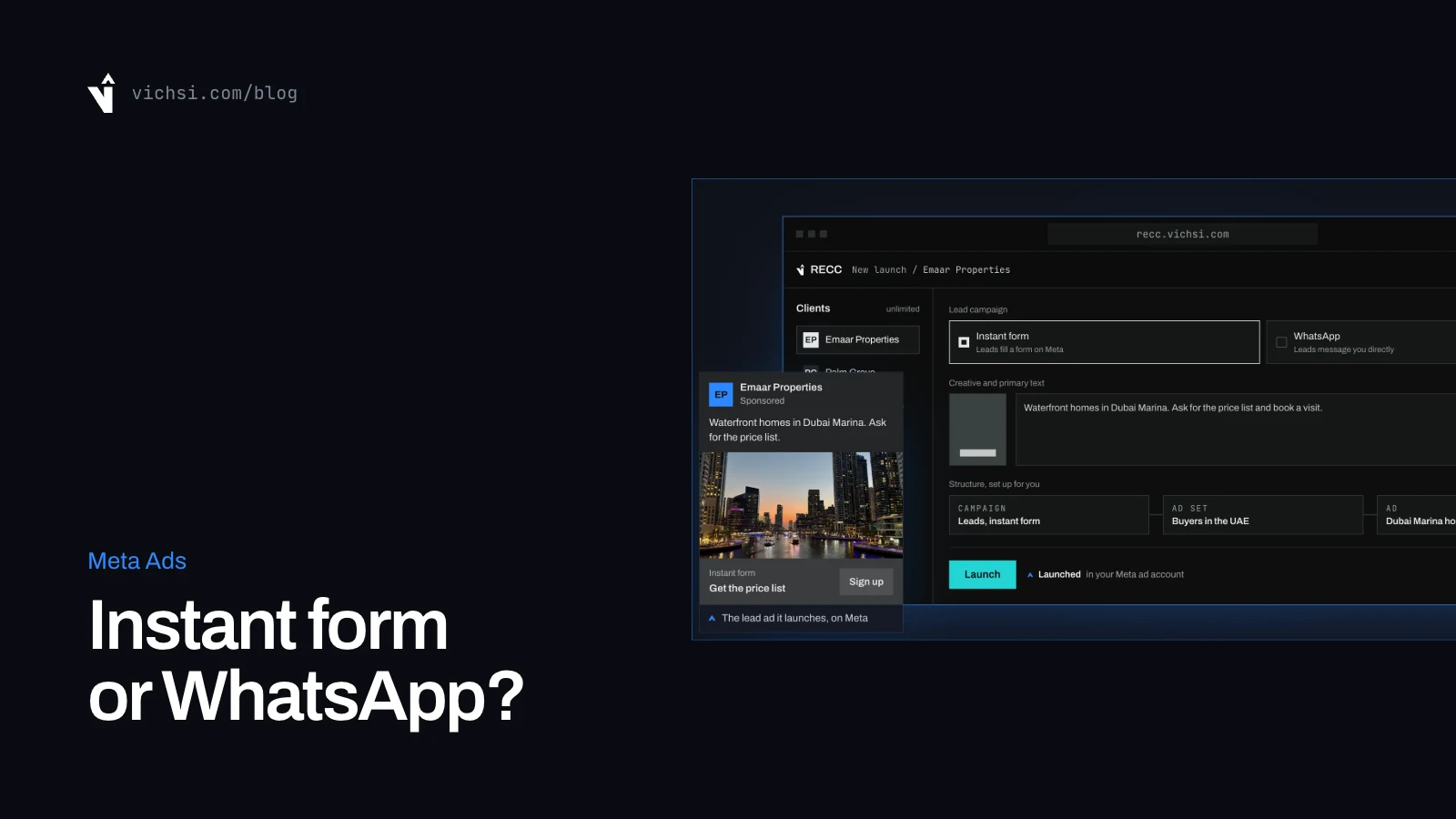
A lead ad is an ad whose goal is to collect a person's contact details or start a conversation, instead of sending them to a website. On Meta you create it with the Leads campaign objective and then choose where the lead happens:
- Instant forms: a form opens inside Facebook or Instagram, pre-filled with the person's name, email and phone number from their profile. They check the details and submit in a few taps.
- Messaging apps (WhatsApp, Messenger, Instagram Direct): the ad opens a chat with your business, often with a ready-made opening message.
- Website or calls: the ad sends people to a landing page or starts a phone call. These work too, but they add a step, so most property advertisers start with forms or WhatsApp.
Instant forms or WhatsApp: which one should you use?
Both work. The right choice depends on how your sales team works, not on which one is newer.
| Instant form | Click-to-WhatsApp | |
|---|---|---|
| What the buyer does | Submits a short pre-filled form | Sends you a message on WhatsApp |
| What you receive | A row of contact details and answers | A live chat thread |
| Best when | A sales or call-centre team calls leads back | Agents answer and qualify in chat |
| Lead volume | Usually higher, because the form is effortless | Usually lower, because the buyer has to write |
| Lead intent | Mixed: some people tap without much thought | Often higher: starting a chat takes intent |
| What can go wrong | Fake or careless numbers, slow call-backs | Unanswered chats, especially at night |
A simple rule: if nobody will answer a WhatsApp chat within minutes, don't run WhatsApp ads. A form waits for you; a chat goes cold.
When instant forms win
Instant forms are the default for launches with a strong call-centre or sales team. They produce structured data (name, phone, answers) that moves straight into a spreadsheet or CRM, and they scale well when you need volume for a new project.
Meta offers two main form types. More volume keeps the form as short as possible. Higher intent adds a review screen where the person confirms their details before sending, which lowers volume but tends to filter out accidental submissions. For expensive property, higher intent is usually worth testing.
When WhatsApp wins
Click-to-WhatsApp ads suit markets where buyers already talk to developers and brokers on WhatsApp. The conversation starts warm, the agent can send brochures, payment plans and location pins in the same thread, and the buyer has the number saved for later.
To run them, your Facebook Page needs a connected WhatsApp Business number, and someone must be ready to reply. A pre-filled opening message (for example "Hello! Can I get more info on this?") makes it easier for the buyer to send the first message.
How do you set up a real estate lead campaign on Meta?
The steps below follow Meta Ads Manager. The names of buttons change from time to time, but the decisions stay the same.
- Create the campaign with the Leads objective. If your market requires it, declare the Housing special ad category at this step.
- Set the budget. Campaign budget lets Meta move spend between ad sets; ad set budget gives you more control while testing. Start with a budget that can produce a meaningful number of leads per week for one ad set, rather than spreading a small budget thin.
- Choose the conversion location: instant forms, or messaging apps with WhatsApp.
- Pick the Page (and the WhatsApp number for WhatsApp ads).
- Set the audience. For property, location matters most: the city or areas where your buyers live, plus any markets that buy from abroad. Keep age and interests broad and let the creative do the targeting.
- Keep placements automatic unless you have a clear reason to remove one.
- Build the form or the opening message. For forms: a clear headline, the project's key promise, one or two qualifying questions, and your privacy policy link (Meta requires one).
- Add the ads: two to four creatives per ad set, each with its own angle (the view, the payment plan, the location, the lifestyle).
- Launch paused, review, then publish. Check every field once more before you switch it on.
Which questions should a real estate lead form ask?
Every extra question lowers the number of leads and raises their quality. For most projects, one or two questions are the right balance:
- Budget or price range: the fastest filter for serious buyers.
- Timeline: "When are you planning to buy?" separates ready buyers from browsers.
- Unit type or size: useful when a project has very different products, such as apartments and villas.
- Cash or instalments: helpful when payment plans are a key part of the offer.
Avoid asking for information the sales call will get anyway. The form's job is to start the conversation, not to finish it.
What does a good campaign structure look like?
Simple structures learn faster. A practical starting point:
| Level | What to do | Why |
|---|---|---|
| Campaign | One per project and lead type (for example "Project A, instant form") | Results and budgets stay readable |
| Ad set | One or two, with broad targeting in the right locations | Meta's delivery needs room to find buyers |
| Ads | Two to four creatives, each with a different angle | You learn which message sells the project |
Resist splitting one small budget into many ad sets by age, gender or interest. Each ad set needs enough leads to learn, and splitting slows that down.
How do you measure real estate lead quality?
Cost per lead (CPL) is the number everyone sees first, and it is the easiest one to fool yourself with. A campaign with a low CPL and no site visits is worse than one with a higher CPL and real meetings.
Track at least these four numbers per campaign:
- Cost per lead: spend divided by leads.
- Contact rate: the share of leads your team actually reaches.
- Qualified lead rate: the share that matches budget and timeline.
- Cost per qualified lead: spend divided by qualified leads. This is the number to optimise.
Speed matters as much as the ad. Leads that are called or answered within minutes are far more likely to pick up than leads called the next day, so set up notifications or a CRM connection before you launch. For the formulas behind these numbers, see performance marketing metrics explained.
Do real estate ads need a special ad category?
In some markets, yes. In the United States and Canada, and in some other regions, Meta requires ads about housing (selling or renting homes, for example) to be declared under the Housing special ad category. When you do, some targeting options are removed or limited, such as detailed age and gender targeting and very small location radiuses.
The rules differ by country and change over time, so check Meta's current advertising policies for the markets you target before you launch. Declaring the category when it applies keeps your ads, and your ad account, out of trouble.
How can you launch these campaigns faster?
Building the same lead structure again and again for every project and every client is where most media buyers lose time. RECC was built for exactly that job: you pick a client profile, choose an instant-form or WhatsApp lead campaign, add your visuals and primary text, and RECC builds the proven structure in your own Meta ad account in about a minute, from a laptop or a phone. The campaign waits there until you switch it on.
FAQ
What is the best Meta objective for real estate leads?
The Leads objective. It lets you collect leads through instant forms or start conversations on WhatsApp, Messenger or Instagram Direct, and Meta optimises delivery for people likely to become leads.
Are instant forms or WhatsApp better for real estate?
Instant forms usually bring more leads and suit teams that call buyers back. WhatsApp usually brings fewer but warmer leads and suits teams that sell in chat. Choose based on how quickly your team can respond in each channel.
How many questions should a property lead form have?
One or two qualifying questions, usually budget and timeline. More questions improve quality but reduce volume quickly.
Why are my real estate leads low quality?
The common causes are forms with no qualifying question, the "More volume" form type on an expensive product, creatives that promise something the project doesn't deliver, and slow follow-up. Fix follow-up speed first; it is the cheapest improvement.
Do I need a website to run real estate lead ads?
No. Instant forms and WhatsApp ads work without a website. You still need a privacy policy link for instant forms.