Performance marketing metrics explained: CTR, CPC, CPM, CPL, CPA and ROAS
The core paid advertising metrics in plain words, with the formula for each, a worked example, and which number to trust for leads and for sales.
Short answer
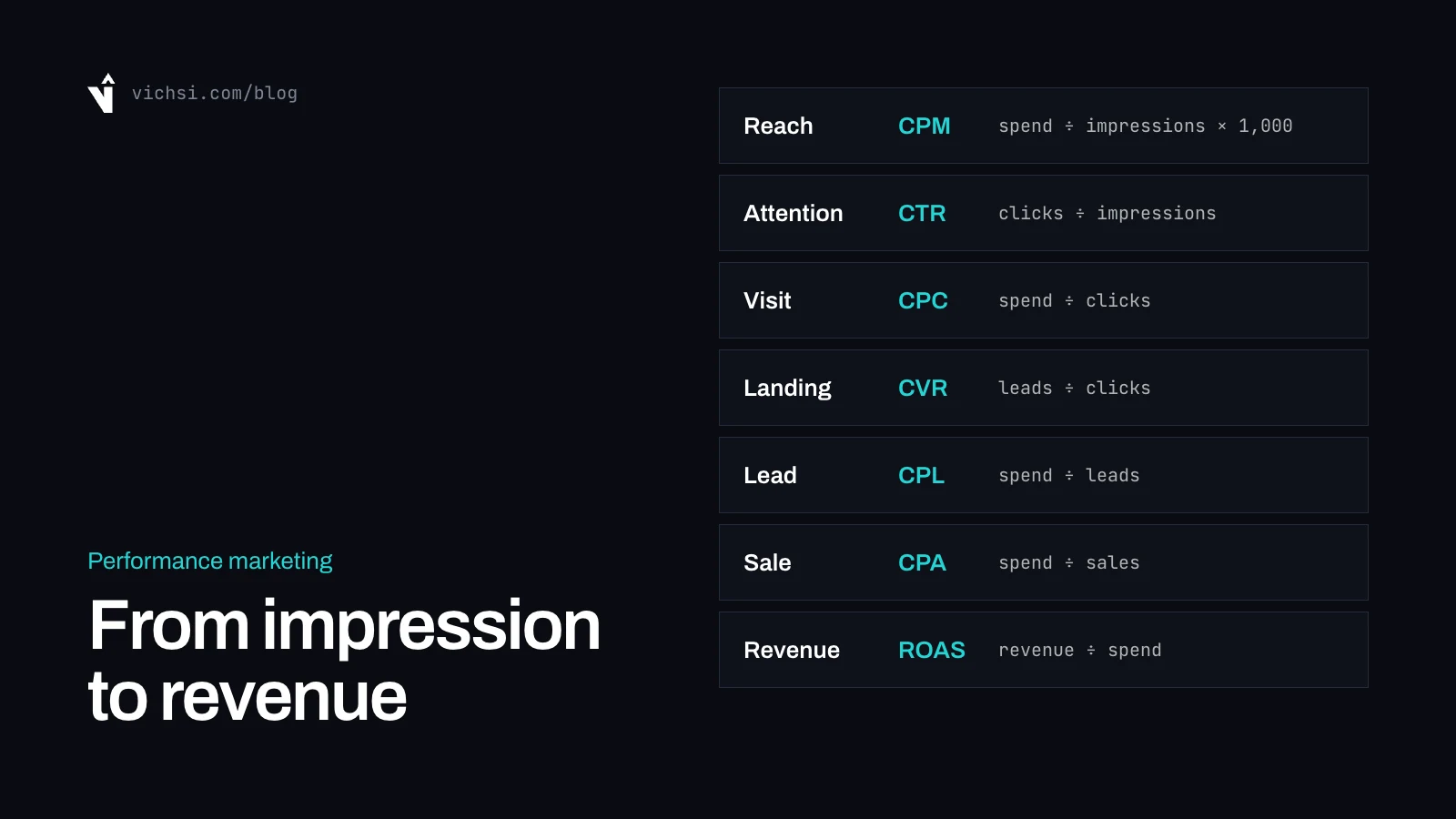
Performance marketing metrics measure each step from impression to sale: CPM is the cost of reach, CTR and CPC measure the click, CVR measures the landing, CPL and CPA measure the cost of a lead or a sale, and ROAS measures revenue per unit of spend. Optimise the metric closest to real money you can reliably track.
Performance marketing is advertising you pay for and judge by measurable results: clicks, leads, sales. Every platform reports dozens of numbers, but a handful of them explain almost everything. This guide defines each one, gives the formula, and shows how they connect.
What are the main performance marketing metrics?
| Metric | Stands for | Formula | What it tells you |
|---|---|---|---|
| CPM | Cost per mille (thousand impressions) | Spend ÷ impressions × 1,000 | The price of reach |
| CTR | Click-through rate | Clicks ÷ impressions × 100 | How compelling the ad is |
| CPC | Cost per click | Spend ÷ clicks | The price of a visit |
| CVR | Conversion rate | Conversions ÷ clicks × 100 | How well the page or form converts |
| CPL | Cost per lead | Spend ÷ leads | The price of a lead |
| CPA | Cost per acquisition (or action) | Spend ÷ conversions | The price of a sale or chosen action |
| ROAS | Return on ad spend | Revenue ÷ spend | Revenue earned per unit of spend |
How do the metrics connect? A worked example
Here is one campaign followed through the funnel. The numbers are round on purpose, to make the maths easy to follow.
| Step | Number | Metric |
|---|---|---|
| Spend | 1,000 | |
| Impressions | 200,000 | CPM = 1,000 ÷ 200,000 × 1,000 = 5 |
| Clicks | 2,000 | CTR = 2,000 ÷ 200,000 = 1%; CPC = 1,000 ÷ 2,000 = 0.50 |
| Leads | 100 | CVR = 100 ÷ 2,000 = 5%; CPL = 1,000 ÷ 100 = 10 |
| Sales | 5 | CPA (per sale) = 1,000 ÷ 5 = 200 |
| Revenue | 4,000 | ROAS = 4,000 ÷ 1,000 = 4 (often written 4x or 400%) |
The chain shows where to look when results change. If CPL rises, check each link: did CPM rise (more competition), did CTR fall (a tired ad), or did CVR fall (a broken form or page)?
What is CPM and when does it matter?
CPM is what you pay for a thousand impressions. You don't control it directly; it depends on the audience, the season and the competition. It matters most when you compare markets or audiences: a market with a much higher CPM needs a stronger conversion rate to make the same cost per lead.
What is a good CTR?
It depends heavily on the platform and the format. Search ads usually have far higher click-through rates than social feed ads, because the person is already looking for something. Instead of chasing a universal benchmark, compare CTR between your own ads: the ad with the higher CTR is usually the clearer message, as long as its leads are just as good.
What is the difference between CPL and CPA?
CPL counts leads: people who gave you their details or started a conversation. CPA counts whatever action you define as the acquisition, often a purchase or a signed customer. For lead businesses such as real estate, CPL is visible in the ad platform within hours, while the real CPA (cost per sale) appears weeks later in the CRM. Track both.
A useful bridge between them is cost per qualified lead: spend divided by the leads your team confirms as real buyers. It reacts as fast as CPL but behaves like CPA.
What is ROAS and what is a good ROAS?
ROAS is revenue divided by ad spend. A ROAS of 4 means every unit spent returned four in revenue. A "good" ROAS depends on your margins: a business with high margins can be profitable at a lower ROAS than one with thin margins. To find your break-even ROAS, divide 1 by your profit margin (as a decimal); a 25% margin breaks even at a ROAS of 4.
ROAS is the natural metric for e-commerce, where revenue is tracked automatically. For long sales cycles, such as property, use cost per qualified lead and cost per sale instead.
Which metric should you optimise for?
Choose the deepest metric you can track reliably and quickly:
- E-commerce: purchases and ROAS.
- Lead generation with a CRM connection: qualified leads or sales, sent back to the ad platform as conversions.
- Lead generation without a CRM connection: leads (CPL), with qualified lead rate checked by hand every week.
- Awareness: reach and CPM, with brand search volume as a check.
Then keep the shallow metrics as diagnostics, not goals. A falling CTR is a reason to refresh the creative, not a result in itself.
What mistakes do people make with these metrics?
- Optimising the cheapest number. The lowest CPL often brings the weakest buyers.
- Judging too early. A few days and a handful of conversions are not enough to call a winner.
- Comparing across platforms naively. A Google Search lead and a Meta form lead are different kinds of lead; compare their sales, not just their prices.
- Ignoring follow-up. Slow call-backs lower your conversion rate from lead to sale, which looks like an ads problem but isn't.
For how these metrics apply to property in particular, see real estate lead ads on Meta and Google Ads vs Meta Ads for real estate.
FAQ
What does CPL mean in marketing?
CPL means cost per lead: your ad spend divided by the number of leads the ads produced. If you spend 500 and get 50 leads, your CPL is 10.
How do you calculate ROAS?
Divide the revenue from your ads by what you spent on them. 3,000 in revenue from 1,000 in spend is a ROAS of 3.
What is the difference between CPC and CPM?
CPC is what you pay per click; CPM is what you pay per thousand impressions. CPC equals CPM divided by (CTR × 1,000), so a better CTR lowers your CPC at the same CPM.
Is a high CTR always good?
No. A high CTR with a poor conversion rate often means the ad promises something the page or offer doesn't deliver.
What is a conversion rate in advertising?
The share of people who complete the action you want after clicking, such as submitting a form or buying. It is conversions divided by clicks.